|
|
 |
|
|
| 02.Oct.26 |
XLOG (German) 🔊 Celebrating 25 Years of XBTF's Magazine Release  |
 |
|
|
 |
In October 2001, X: Beyond the Frontier graced the cover disc of Computer Bild Spiele (CBS), one of Germany's top-selling print games magazines at the time. Appearing on the cover disc provided enormous visibility, bringing the game into countlessly more homes two years after its initial commercial release and proving to be a pivotal moment in Egosoft's history.
To celebrate this 25th anniversary milestone, Egosoft founder and Managing Director Bernd Lehahn takes us behind the scenes in a special German episode of our XLOG video series. You can watch the full video on our YouTube channel (with English CC system subtitles) or read the structured interview transcript below.
YouTube: XLOG (German) 🔊 Celebrating 25 Years of XBTF's Magazine Release
The 2001 Cover Disc Milestone
Hello everyone! Today we are making an Xlog video in German. The reason for this is that today, 25 years ago, "X: Beyond the Frontier" was released for the first time on the cover disc of "Computer Bild Spiele". I keep hearing, especially from our German fans, that this is still a fond memory for many people because it was the first time they ever encountered the X games series. "X: Beyond the Frontier" came out in 1999 as a full-price game - which at the time you bought in a box at a department store - and was relatively expensive. Less than two years after its release, when we received an offer from "Computer Bild Spiele", we decided to put the game onto their cover CD.
Looking back, that was a fantastic decision. It gave us a tremendous amount of visibility, led to even more sales of "X: Beyond the Frontier", and brought us many new fans. Our game became much better known, and shortly after, we released "X-Tension", the expansion for "X: Beyond the Frontier". That really boosted the popularity of our series, especially in Germany. Even today, when I meet fans at trade shows or events in Germany, I constantly hear people say that this cover disc was their entry point into the X series - and fortunately, many of them stuck with us!
A few years later, "X2: The Threat" was released, followed by "X3: Reunion", and so on. Now, as you all know, we are at "X4: Foundations". With all its DLCs, we have been developing this latest installment for over eight years now.
Heavy Boxes and Expanding Lore
I would like to share a few behind-the-scenes stories about how it all started. Back then, Egosoft was a much smaller studio - probably just a little more than a handful of people. I was a programmer myself, and the company was small enough that I couldn't seriously call myself Managing Director, which is my title today. After "X: Beyond the Frontier" became a huge success in its original retail release, we immediately began working on "X-Tension".
During development, Helge Kautz suggested writing a novel set in this universe, which became "Farnham's Legend". That laid the groundwork for the deeper lore and fiction of the X universe. When "X-Tension" was released, I remember the physical box was very heavy because it included a printed copy of the novel inside. In Germany, many fans appreciate physical collector boxes. While it is a bit sad that we can't offer physical boxes for "X4" at that scale today, digital distribution offers incredible advantages for us as developers. The novels are still available electronically today and are included in our "X4: Community of Planets - Collector's Edition".
From Amiga Roots to the 3D Hardware Revolution
How did it come about that we created "X: Beyond the Frontier" even earlier? The release was in 1999, but we had already been working on it for a couple of years before that. Development started around 1995 or 1996. Making a space game was always a personal dream of mine.
In Egosoft's early days - starting in the late 1980s and early 1990s - we made games for the Amiga. We actually attempted a space game on the Amiga that was meant to be bundled with a VR headset, but neither the game nor the headset setup ended up coming to market, so the project was canceled. That was a completely different project with another name, but the idea to do a space game was there much earlier.
The real push to create "X: Beyond the Frontier" came with the rise of 3D graphics accelerator cards around 1995 - first under DOS, then under Windows with DirectX. As a programmer, it was an exciting era because new hardware emerged constantly, enabling features that were previously impossible when relying purely on CPU rendering. Between 1995 and 1999, during the development years, our engine evolved more rapidly than it did over the following decade because new graphics cards came out every year, allowing us to implement nicer ship models and richer backgrounds.
Press Tours and Printed Guides
Industry challenges back then were quite different from today. Nowadays, new indie developers face immense competition trying to gain visibility on crowded platforms like Steam or mobile storefronts. In our early days, we had to travel directly to gaming magazines - such as "Computer Bild Spiele", "GameStar", "PC Games", and "PC Joker" - to pitch previews. "Computer Bild Spiele" made us an offer, and they didn't just put our game on a CD; they featured a thorough review and several pages of gameplay guides, which were arguably better than the manual we included in the retail box. On our end, the biggest technical hurdle back then was building our technology completely from scratch, whereas modern developers can leverage existing engines. When we started, our single-digit team worked on adventure games that weren't particularly successful, financed mainly through promotional games made for German clients.
To market our games, we had to go on preview tours to show editors unfinished builds, hoping for coverage. When the game was finished, we went on a review tour to present it live. That's how we established contacts, and we were thrilled when "Computer Bild Spiele" offered to put the game on their cover CD. Although it was an economic risk, it clearly paid off in the long run.
We actually still have a few of those magazine issues on our shelf today! Back then, we would go to newsstands, buy every issue that mentioned us, and mark the reviews and articles with yellow sticky notes. "Computer Bild Spiele" even had several employees who played our game exclusively for a while to create printed strategy guides.
From a Single-Digit Team to X4: Foundations
That coverage was a huge push for our studio, technology, and series growth. Going from a single-digit team on "X: Beyond the Frontier" to around 50 people working on "X4: Foundations" has been an incredible journey. While "X4" shares the same core vision - freedom in space and open-ended gameplay - it is vastly larger. The underlying economic simulation has evolved dramatically. In "X: Beyond the Frontier", goods were transported between factories, but those goods didn't directly supply ship production or war efforts - the loop wasn't closed. Closing that economic loop without collapsing the universe was one of our major engineering milestones for "X4". Furthermore, with walkable ship interiors, space station docks, and feature-rich maps, X has evolved from a pure first-person cockpit space sim into a hybrid strategy and 4X empire-building game.
Looking Ahead
Our community has grown immensely over these 25 years. We are deeply grateful to everyone who has supported us, whether you joined during the "Computer Bild Spiele" era or discovered us recently. As a small hint for what lies ahead: we have very cool things planned for "X4", and there will be major news coming later this year regarding big developments in the "X4" universe. Be sure to follow us across our social media channels, Reddit, Steam, and the official Egosoft forums for updates. Until then, goodbye! |
|
|
|
|
|
|
| 09.Sep.26 |
Interview with Lino: Egosoft Art Director |
|
|
|
|
In the new episode of Inside Egosoft, Joey chats with Lino, Egosoft’s Art Director and 14-year veteran at the studio. Alongside his own artistic creations, Lino oversees the art team and the overall artistic direction of the X Universe. In this conversation, they discussed everything that goes into the visual experience of an X game: special rules that go into each faction’s designs, some of Lino’s favorite tools and techniques, and even his favorite bug.
Below, you can read some highlights from this episode. Thank you for reading and listening, and please tune in to Inside Egosoft on all major podcast platforms to catch the next episode!
Let us know in the comments if there’s someone from the team or a topic you’d like to see highlighted in a future episode.
🔗 YouTube
🔗 Amazon
🔗 Pocketcasts
🔗 iHeart Radio
Fourteen Years at Egosoft
Joey: Would you like to introduce yourself? How long have you been working here, or in the industry in general?
Lino: Yo, my name is Lino. I'm the Art Director—that's what they call me. I've been working for more than 14 years at Egosoft. I'm getting up to 15, another nice number. And it's really my first proper job. I started at Egosoft as an intern, so it's my first real company. I'm one of those weird people who don't jump jobs and jump ship, but just stay at one company because I like it.
Joey: And what does being the Art Director at Egosoft mean to you on a day-to-day basis?
Lino: It's less about actually doing art than people might think. It's mostly making sure that whatever needs to be done on the art side actually gets done. I'm coordinating a lot, planning tasks for people, making sure they have something to do and don't run out of work. And then, of course, there are all the meetings and discussions with game design and the story teams. So most of the time, it's actually not doing art. It's more about managing everyone and everything around it.
The First Ship
Joey: I know it's been 14 years, but I'm curious if you recall what your first art project was at Egosoft.
Lino: It was a small S-sized ship for X Rebirth. At the time, I had played X before—X: Beyond the Frontier was the first game I played—and suddenly I was at the studio making a spaceship for X. I was like, “Oh yes, cool, I can do a ship!”
I got concept art, because I couldn't design anything myself yet. I think I had about two weeks to make the ship. It was all new. I was so amazed by how clever the techniques we were using at the company were.
Of course, looking back at it now, I did so many things wrong. But for someone just starting out, not knowing much about low-poly workflows, atlases, trim sheets and all the techniques you learn, looking back at it, it was okay. I have good memories of when I started here, all the things I didn't know at the time, and how excited I was to be starting.
Learning to “Debug” Art
Lino: I fear the day when I look back at an asset and think, “No, this is perfect,” because then I know I've stagnated. There was one artist I really highly regarded who was here for one year, and he taught me design. Before that, I didn't really have an idea about it. I just had gut feelings.
I'd have a ship that looked good, but I didn't know why it looked good. I'd have a ship that looked bad, and I couldn't figure out why it looked bad. He gave me the tools to actually debug my art.
Joey: When you talk about debugging art, do you mean there's an aesthetic problem and you're looking at it almost like you're debugging why it doesn't look right?
Lino: Exactly. It's not technical. When I talk about debugging art, I mean the visuals. I have my checklist of design principles. Whenever I'm stuck, I open this text file and look through them.
If I'm stuck, I can look at the rules: “Is there a nice rhythm in the artwork?” “Oh, no, there isn't.” So I'll add rhythm.
Inspiration Starts with a Problem
Joey: Where do you tend to derive inspiration when you're working on art? What things tend to make an idea pop into your head?
Lino: I usually get a problem put in front of me. The problem is: design X, design Y. Then I look at the problem. “Okay, I have to do a Split ship. What do they do? How do they work?”
It's not like I'm sitting there thinking, “I have to do art now.” Having a problem gives you a riddle you want to solve, and with that riddle your mind immediately starts looking for solutions. The inspiration comes from brainstorming about the problem.
Of course, I love looking at nature—the crystals in nature, geometric shapes, maybe some maths. But everything around us shapes us. Over our whole lifetime we remember things and have feelings about certain things, so you dip into that and get inspiration from it.
Constraints and Happy Accidents
Joey: Constraints really help you be creative because you have a limited selection of things you can do. As opposed to having this infinite expanse of options where you can get paralysed, being constrained by your options can lead you to be a little more inspired and creative.
Lino: I absolutely agree. With no constraints, the direction is missing. The more constraints you get, the more the road is shaped.
Sometimes those rules also create happy accidents. I still remember the scrapping ship that takes in scrap and, as I call it, “poops out” a scrap cube. The scrap cube was pretty big, so I needed a ship that could expel a scrap cube in a certain direction.
That limitation—how big the cube was and which direction it needed to go—forced me to make the ship look really, really weird. But I loved how it looked in the end. The cube needs a free path, so I had to model the ship around this virtual empty space.
That forced the ship into this odd shape, but it fit the scrappy, piratey look really well. Then people can look at it and think, “Ah, that's why it looks like that. Of course the scrap cube needs to fly out there without hitting the ship.”
What Makes X4 Look Like X4?
Joey: Is there something that immediately makes an asset recognisable as something from X4?
Lino: For players, I can't say that I personally think there's a single asset that screams X4. If you showed a single asset standing on its own, it might look like it belongs to any space game.
Maybe it's everything together. You have cool space backgrounds, lots of spaceships, small ships you can get out of and walk around on, stations stuck together, all the different races. Maybe it's the mixture of races. We have the Split, and the Split are very unique.
You may see similar individual things elsewhere, but it's the combination of these crazy, different-looking things in one big sandbox. I can't say one single asset is really X4. It's the combination of things together that is really X4.
The Sense of Scale
Lino: I like having the on-foot walking, even though it's an incredible amount of work to make it function. But it's worth it for the sense of scale we can convey that way.
I love watching people play the game for the first time. It's beautiful when someone lands their ship on another ship for the first time, gets out, and realises, “Holy moly, this is big.”
“This is an S ship.” It's not just the letter S. Then you walk onto your first M ship and see how bloody big it is. “Holy—this is just an M ship. We still have L ships and XL ships.”
It gives them more value and atmosphere. Sense of scale is important.
I guess everyone can remember the first time they saw a Xenon I in the far distance. You get closer and closer, and it still takes so long to reach it. Then you realise, “Oh, this thing is actually huge.” And finally you arrive and think, “Holy… this is a crazy big ship. I probably shouldn't be here.”
Finding the Boron Design Language
Joey: How do you start when you're designing a ship for a given faction? Are there certain rules that you have to keep in mind, like for the Split or Boron?
Lino: I'll take the Boron because they're the most recent case where we had a full redesign, and I'm really proud of what we came up with.
Most of the races have been seen before in earlier X games, so I can't simply imagine whatever I want. I always have to look back at what came before. The X3 Boron were greenish, with bloated ships and organic shapes. So we said, “Let's take this further.”
Then you establish the ground rules. What are the Boron? Aquatic lifeforms. So maybe you look at things from Earth's oceans. Of course, you think of fish, but while digging for references I found things like phytoplankton. Their skeletons looked bloody amazing. They had these really complex, crazy shapes and interesting surface details.
We tried to distil why they felt that way and found a rule. Imagine a wave on the ocean. The crest is sharp, while the valley of the wave is smooth. That's one of the principles of Boron design.
Whenever you have a convex shape—a crease pointing outward—you sharpen it. Whenever you have a concavity or depression, you soften it. So you get this wave-like shape.
Designing Ships Around Metaphors
Lino: For the Boron, I try to convey metaphors. When you look at the ship, its shape should give you some idea of what it does. Dangerous ships should look dangerous.
A good example is the Boron destroyer compared with a Boron mining ship. The destroyer looks a little bit like a shark. Not literally, but it has elements of one. It has a kind of jaw at the front with repeating sharp shapes that look a little like teeth.
It looks dangerous. By adding these little sprinkles of inspiration, we get the metaphor that this is something dangerous. It's a hunter.
Then we have the gas miner, which has this very wide, open, smooth mouth inspired by filter-feeding fish. With that metaphor, you can see that this isn't dangerous. It's smooth. It probably isn't going to kill me.
They're both Boron, but even within one race's design I try to distinguish between something more dangerous and something friendlier.
The Paranid Rule of Three
Joey: The Paranid, of course, have three as their holy number. I imagine you try to do lots of trios when you're designing a Paranid ship, right?
Lino: Yes. I wouldn't quite call it a running joke, but with everything Paranid, we look for where we can put the number three.
If you have radial symmetry, it's three-way symmetry—120 degrees, because you're dividing a circle into three parts. If the Paranid consider three holy, then every time we see something Paranid in the art department we ask, “How can we put the number three in here and make it pure and holy?”
If it's not three, it's unholy and doesn't work. You try to get into how the Paranid might think. That also plays into their religious character. Everything is very cathedral-like and imposing in a weird way. We try to convey that through the architecture inside their ships and stations as well.
Why Boron Ships Aren't Full of Water
Lino: A lot of the races have quirks, and you try to lean into them. Of course, it's not always possible because of the limitations of how our game works and the fact that humans—or other creatures—need to be able to walk around inside these things.
You can't fill the Boron ships with water because there has to be a human inside. So we invent a rule: it actually makes sense that they wouldn't fill the whole ship with water because the water makes it heavy and means it can't rotate as quickly.
That's a nice excuse for why the ships aren't filled with water, and it saves us from having to invent some weird way of filling them with water.
Joey: I like to think the Boron are just really friendly guys. They want you to visit them.
Lino: That's a nice way of putting it. Okay, that's why we did it.
But we have a corridor in the Boron interiors where, on the right-hand side, there's a glass tube that's slightly hidden. From time to time, a Boron swims through there.
It doesn't happen very often, and usually you're just running through the corridor. Then I finally saw somebody on Reddit saying, “Oh, there's a guy floating through there.” I was happy somebody had spotted that little bit of work.
Keeping the Universe Visually Fresh
Joey: How do you keep everything visually fresh and prevent things from becoming too repetitive?
Lino: The fun thing about the design rules is that they're procedural in a way. Even slightly changing how you interpret one rule gives you a very different result.
By varying the underlying foundation of rules, I can force an artist to approach an asset completely differently. And the funny thing is that I'm not even sure every artist in the office is consciously aware of the rules or could name them. Over the years, you get a feel for them.
There are also artists where I don't really know what rules they're following. I just let them cook and get amazing stuff out of it. I think, “Oh yeah, that looks good. Let's make a rule out of this.”
I personally like to think in rules and hard rules. Other artists are completely different. They just flow and everything starts to come together beautifully. They're different approaches that converge on the same result.
When Fewer Polygons Weren't Faster
Joey: What kinds of problems are you solving when you're trying to make a model that both looks good and is performant?
Lino: When I was a little artist, I didn't know much about optimisation. We had one scene looking at a station where the number was something like 10,000 draw calls. At the time, the usual limit was around 1,000 to 2,000, so that was a pretty high number.
We have levels of detail. Things close to you are high-resolution and have all the detail. The further away you go, the fewer polygons you need. The artists had taken the assets and decimated them down.
Cool. The polygon count is lower, so everyone thinks, “Fewer polygons. It should be faster.”
No. It wasn't faster.
The station modules still had something like 15 materials, and those materials were causing 15 draw calls. The CPU was still screaming at the GPU, “Draw these 15 materials,” even though the thing was tiny in the background.
So I sat there for about three months making every LOD3 use one draw call, maximum two. And then the game ran so much better.
Over time, you just learn. I still twitch when I see an asset with too many materials. I can't get rid of it.
How the Xenon Cockpits Fool You
Joey: Is there anything in X4 that looks visually complicated but is actually achieved through a clever trick?
Lino: We fool the players sometimes. The Xenon ships are probably the best example.
You get into the ship and there's a monitor in front of you. It flickers. It's off, then it turns on, and then the real game appears to be rendered on the screen.
Those aren't actually screens. It's a completely normal cockpit.
To make the effect work, while that animation is happening and you're in the cockpit, we fade out the outside geometry of the ship. It looks like you're sitting inside the core of the ship looking through cameras or monitors to the outside.
We fool the player into thinking it's a real screen with this extremely high-resolution view. I'm probably breaking somebody's heart by telling them this, but it's just a normal cockpit.
We tried to find a cheap, quick way to get the same result without investing the technical effort needed to do it “properly.” I think that's a nice little hack for a good result.
Working with a Custom Engine
Lino: What's it like working with a custom in-house engine? Yeah, it's a struggle.
Of course, it's nice to have your own engine, but everything is custom-made. I won't complain too much because, in the end, what we've been able to build with it is incredible.
But as an artist, of course I look at Unity, Unreal and Godot. They have what-you-see-is-what-you-get editors. Everything is polished. And if you have a problem, you can Google it.
With a custom engine, if you have a problem, you first have to figure out who the heck implemented this thing. Then you find out it was somebody 20 years ago because that part of the engine has been carried over.
But the nice thing is that you can request features. You can say, “Man, I'd love to have this graphics feature,” and if you're lucky someone says, “Yeah, sure, let's do it.”
Over time we just improve and improve and improve the engine. I'm happy that we have it and we're independent rather than relying on somebody else, because then we can improve it and fix it ourselves.
I don't think you can make X with an engine like that. You can't have 10,000 or 20,000 ships running at the same time in a fully simulated universe, with every little transaction doing something.
Who does this? Why? Because we can. I love it. I love this game.
Building Space with Fractals
Joey: You mentioned that you use the IFS Renderer for fractal stuff. How does that factor into your art?
Lino: IFS Renderer—game-saver. Lifesaver, even.
When we started X4, I didn't really know how to make good space backgrounds and nice space environments. Everything was kind of handmade. We even had experiments where ink was dropped into water and photographed to produce something that looked like a space nebula.
But because I knew what had been done, I could see the ink.
Then I found IFS Renderer, which is fractal-rendering software. Normally you think of Mandelbrot-type things and cool fractal shapes, but there are ways of recombining things where everything kind of explodes and you get these space backgrounds.
Over time, I learned how to get things like supernova explosions. Because it's fractal, it's essentially a three-dimensional thing made from point clouds. You can fly around inside this world you've built, like a little universe, find a nice camera position and render it out.
It's really 3D. You're not just plastering 2D textures together. You're flying around, trying to find a nice angle.
Sometimes you rely on these small tools made by passionate people, and I can't thank them enough for doing that work and letting us use those tools to make good art.
Using Things in Unexpected Ways
Joey: What's the weirdest or most unexpected tool you've ever found useful for making art for X4?
Lino: The thing is, as soon as you use a tool, it isn't weird anymore. Once it's part of your pipeline, you think, “Oh yeah, that's normal.”
Sometimes it's more about where I get things from. I once took a picture of my phone screen because it was nice and dirty, and used that picture to make the glass in cockpits and on consoles dirty.
In game art, we do this kind of thinking outside the box all the time. For example, we have RGB channels. Any colour is defined using RGB, but those channels don't actually have to contain colour information.
You can encode other things in them—for example, position. Don't think of colour channels as only colour. You can abuse those data channels for completely different contexts.
Every Artist Has a Handwriting
Joey: How do you balance the artistic individuality of the different artists against making a unified visual style?
Lino: I have the advantage that I have people who are mostly interested in particular races. I use their interests and let them work on those races when I can.
Every artist has a handwriting. I have one artist who loves doing Xenon stuff. Another loves Paranid art. Etienne loves the Terrans.
Even if I asked one of them to work on a different race, their handwriting would still come through. If I ask someone who's used to Xenon to make a Boron ship, you might look at it and think, “Is there some Xenon in there?”
No. That's just the artist.
So whenever I can, I let artists work on the race they're most familiar with and happiest working on, where their handwriting already aligns with the style.
When Is an Asset Finished?
Joey: Once you're towards the end of the process, how do you know when an asset is finished?
Lino: As an artist, an asset is never finished.
Joey: Only abandoned.
Lino: For the producer, an asset is finished when time is running out. Mostly, we have to set time goals. You have X weeks for an asset. After those X weeks, it has to be done.
An asset is done when it's technically working and usable in-game. You try to do your best, and at some point you pull the brake and say, “No. Finish it. Wrap it up. Two days to get it into the game and make sure it's working.”
Then you move on to the next one.
Guiding the Player's Eye
Joey: Gamers famously don't look up. If you worked really hard on the ceiling, do you use visual guides to make people look up? Maybe a cable leading them towards it?
Lino: We try. When I have areas where I want people to look at something, I take everything out of my repertoire.
The problem with game art is that players can look anywhere, so you rarely have the opportunity to properly frame something. Lighting helps a lot. Gradients in lighting can say, “Here. Look there.”
Pipes are just a way to get a line into the composition. A line can be created with light and shadow, value contrast, colour contrast or a physical cable. Anything that guides the eye.
When you look at ships from the outside, I use a lot of lines to guide the player towards something. “The cockpit is there. I want you to look there.” “The shield generator is there.”
I'd love to proudly say that no line we put into the game is unintentional. Of course, sometimes it is. But with the main lines, there's an underlying reason why they're positioned that way.
You may not consciously notice it, but you feel it.
Creating a Feeling Without Explaining It
Lino: If you do it right, nobody really notices. Or they notice it, but they can't put their finger on why. If you do it wrong, everybody says, “Oh, this doesn't look great.”
We try our best to make things pleasing without people necessarily knowing why they like them. I'm completely happy if players don't know what we're doing and simply see something and say, “This is my favourite ship. It looks so cool.”
The thing I'm particularly proud of is conveying a feeling through an asset. As soon as I manage to evoke a feeling when you see something, I'm so happy.
Look at the Split architecture. The bridges are narrow and tall, so it feels like the walls are closing in and pressing down on you. The Boron are very open, wide, round and inviting.
It's about invoking some kind of feeling, and I hope it's the right one when you enter that place.
“More Atmosphere!”
Joey: If you could completely ignore performance, production time and practical limitations—if you had an army of designers working for you—what would you love to have in X4?
Lino: On the player-facing side: more atmosphere, exclamation mark.
Everything that makes it feel like a world. I would love to convey that creatures actually live there, doing their daily business. They're going somewhere to do something, and everything is there for a reason.
Small dioramas where you can look into the world and observe it. I love that feeling of looking into an aquarium, watching the fish going around doing their fishy business. I'd love to have more of that in X4.
Make the world feel full and rich, so around any corner there's something to explore. I'd love to have more time and resources to put things into the game that 99 percent of players will never see.
Because if you do find one, you think, “Man, that's cool. I'm going to tell my friends.”
Two Props Can Tell a Story
Lino: I remember seeing a picture from GTA IV of a used mattress outside, bent against a wall, with maybe two bottles of beer next to it.
Somebody sat down and put time and effort into thinking, “I want to tell this little story, and all I have is a mattress and a bottle of beer.” You instantly get images in your head. Why is this mattress here? Is somebody living there? Did they get kicked out of their flat and now they have to sit outside?
Somebody put the time and effort into taking two props and arranging them in a way that tells you a story. I adore these things. Good work, whoever that artist was. You'll probably never hear this podcast, but I appreciate that you put that mattress there and told that story.
Joey: Shout-out to the mattress guy in GTA IV.
Lino: Good guy.
Lino's Favourite Bug
Lino: My favourite bug in the game. Lovely story. In X Rebirth, at some point we implemented the external camera. You could click on any object and look at it from the outside.
Of course, you went onto your ship, clicked external camera, and saw your ship from the outside. Cool. This works. Then you target a station, click the station and say, “Show me the external camera view.” Cool. I see the station from the outside.
Wait a minute. The station is moving. Oh. I am the station. I can fly the station. So for a short amount of time in X Rebirth—on development builds—you could select a station and actually move the station to a different location like it was a ship. That was fun. I loved that.
Final Thoughts
Joey: Are there any final remarks or anything you'd like to share with listeners?
Lino: I appreciate that they're here. Be kind. Be curious. |
|
|
|
|
|
|
| 13.Aug.26 |
Interview with Alexei Zakharov: Egosoft Composer and Sound Designer |
|
|
|
|
In the latest episode of Inside Egosoft, Joey sits down with Alexei Zakharov, composer and sound designer for Egosoft since 2003. Alexei is responsible for most of what you’ll hear in X4: Foundations, from the atmospheric music in your favorite sectors to the hum of your ship’s engines.
Since Alexei and Joey share many similar experiences as longtime musicians and producers, this episode contains some musings about their shared experiences in the field such as writing styles, inspiration, tools and techniques, and the details that listeners don’t always notice.
Below are some highlights from the conversation. Tune in to Inside Egosoft on all major podcast platforms to listen to this episode, and watch out for a new one later this month!
Listen to the Inside Egosoft Podcast:YouTube
Amazon
PocketCasts
iHeartRadio
Getting Started with Egosoft
Joey: How did you first become involved with Egosoft, at the very beginning?
Alexei: It was a long time ago. As far as I remember, it was summer 2003. I was a big fan of space games and movies when I was a kid. My first gaming platform was the ZX Spectrum. The most famous space game on the ZX Spectrum was Elite. I would call it the grandma of all space games.
When I had my first PC, I got my hands on X: Beyond the Frontier, and I was really shocked. Finally, that was it - the one I'd always wanted. When they announced X2, I was following every piece of news, every update they had. But one day I thought, “No, I am a musician, and I have to do something.”
“We Don't Need Any Techno Music”
Alexei: I was brave enough to write to Egosoft and tell them how much I loved the previous games, how amazing they were, and how I couldn't wait for X2. I said that, as a composer, I would like to propose that they use my music. After several days, I got a response. They said, “Thank you very much for your feedback. We appreciate it very much, but sorry, we don't need any techno music.”
I suppose that was some kind of misunderstanding or mistranslation. I was brave enough to send my track anyway, and maybe one day later I got a reply saying, “Oh, we like that. We like that a lot, and we definitely will use that music in our game.”
Ten Minutes Before the Deadline
Alexei: Then in August, they were making a rolling demo for X2. It was a demonstration of the game's engine, and they needed four different tracks for it. But there was a catch. I had to do it in a very tight time period. I think it was something like two or three days. I still remember delivering the tracks about ten minutes before the deadline. That was August 2003, I think. I would say that was the first time, and the first day, that I started working on X2.
The First Track
Joey: Do you recall the original demo you sent them?
Alexei: The first track I sent them - the one they said was amazing - was a track called “ Aurora.” You can find that on our X3: Albion Prelude soundtrack. I composed “Aurora” with my partner in crime, as I always say. His name is Pavel. We worked on trance tracks and electronic music tracks together, and he helped me a lot with composing “Aurora.” Before that, I hadn't sent any tracks. I had just said that I was making electronic music, and they thought I was making some kind of techno music.
What Has Changed Since 2003?
Joey: You've been a part of the musical identity of X for a pretty long time now. Looking back, has your approach changed much from your earliest work compared to today?
Alexei: To be honest, I don't think much has changed at all. I would say that software and hardware have evolved. Hardware is always changing, software is always evolving. But in my approach to sound design and music design, I don't think much has changed. You gain experience while learning all the new hardware and new software, and you never stop learning. If you stop learning, your music will start to stagnate and degrade. I think that's the most beautiful thing about our experience: we always have to learn something new.
Joey: You know, just the other day, I was actually talking about this over lunch with another friend of mine who's also a musician. We were talking about our old ideas, and how things I made when I first started - I almost wouldn't change anything about that. It’s the same brain. Musically, I’ve never really changed as a person. I love my old ideas. The only thing I would change, really, is that the mix would be a little better.
Alexei: People always say that we tend to love our first music genres when we are just 13 or 14 years old. Our taste is established around that age, and after that, we never lose that. It will evolve - it will change a little bit - but you still love all the music you loved back in your teenage years. The same is for music creation. I started composing back when I was 14, and after that, I think I still have the same core approach.
Shaping the Sound Together with Players
Joey: Do you remember a particular track from the early X games that made you think, “Yes, this is what X should sound like”?
Alexei: I don't think there's really one particular track, because it's a collaboration with the players. When you create something, you never know whether people will like it or not. But after some time, you get feedback from the players. You start to understand what people want to hear more of, what they don't like, and what kinds of compositions they appreciate more. So maybe it's a kind of collaboration with people afterward.
Writing Music Players Remember
Joey: How do you approach composing for a game where players can spend hundreds or even thousands of hours just existing in this universe?
Alexei: I don't think I'm doing anything intentionally. I just do what I feel is right. I'm not trying to attach myself to any specific genre or mood. What I'm trying to do is compose not just a track, but a song, with the structure of a song. I'm always trying to add some motif or idea that people will remember, and maybe they'll try to sing it without even noticing.
You may have noticed that a lot of game soundtracks nowadays are a bit forgettable. That's what I'm trying to avoid: making forgettable music.
Where a Track Begins
Joey: When you start writing a track for X specifically, how do you usually begin your process?
Alexei: It's always different. I would say it's a combination of processes. I try to talk to our designers - the people responsible for narrative, game design, and lore. We have a discussion, we talk, and then I start trying to compose. But even before that, I'm always trying to have many, many ideas collected in my head.
Even if I don't have a major task to compose a specific track, I'm always trying - morning, evening, midday - to sit at my keyboard and compose lots of ideas. If one of those ideas later connects with something we discussed, then I try to start a track from that.
Waking Up with an Idea
Joey: Maybe I wake up one morning and have an idea for something that sounds heroic, you know?
Alexei: Exactly! One of my tracks happened exactly like you explained. I was sleeping - or trying to sleep, but couldn't - and in my head I suddenly had an idea. I wanted to make a kind of choir with an electronic choir sound and make it completely as one. So I just woke up and started composing a theme.
Music and Player Emotion
Joey: How much do you think about things like player psychology or emotions when you're writing music?
Alexei: I don't think about psychology. I think about their feelings. I try to translate my own feelings through the music, and if people feel the same, I'll be happy. That's my goal.
Joey: Would you say you're trying to guide emotion when you're writing music for the game?
Alexei: I think the emotion I'm trying to produce through my music - the emotion I'm trying to convey to them - is about what that specific situation requires. If people in our company tell me they need this kind of track and this kind of emotion, I try to feel the emotion they're describing. I try to transform myself into that emotion.
“Positive Sadness”
Joey: Is there a favorite type of song for you, or a specific mood or atmosphere that you like to work with?
Alexei: One of my favorite kinds of sound or mood is what I call “positive sadness.” A lot of my tracks have that positive sadness. They're sad tracks, emotional tracks, but they're never completely dark or hopeless. That's my favorite thing to do. But the second one is the opposite. I love doing something like a full-blown orchestra - like Hans Zimmer - plus maybe guitars and something like that, with a full trailer-style sound.
The Signature Sound of X
Joey: Are there instruments or plugins that have become part of your “signature sound”?
Alexei: To be honest, the signature sound of X, I think, is the Virus TI - the Access Virus TI. That was the first hardware synthesizer I ever got. I would say it's the most versatile and one of the most beautiful-sounding synthesizers I've ever had. And yes, I would say that's maybe the sound of our game.
Time Restraints and Finishing Tracks
Joey: Does it come up often where you're working on music for X and think, “What if I remove this instrument and it fits the soundtrack better?”
Alexei: To be honest, I never do that. The most beautiful thing in our work is the time restraint. You always have to do something very fast, and because we have that time restraint, you don't have time to overthink things. Throughout all these years, I've learned one thing: always finish your track. If you start a track, you have to finish it. You have to have that kind of discipline in you. But if you overwork it - if you spend much more time than you should - you can ruin your track.
Joey: I have a personal style that drives one of my musician friends crazy. When I think I’m done with a song, I try to go through it and remove as many things as possible. It’s something I’ve done for many years. “Can I take out this drum kick? Can I remove this chord here?” Like I’m trimming the fat. He hates watching me work in the studio because I’ll delete things and he’ll say, “But that was really cool!”, and I’ll say, “Well, the message is the same even if it’s gone. So do I really need that part?”
Alexei: I have a friend - his name is also Alexei - and he has the same problem as you. He has a lot of demo tracks composed, but few of them are finished. Through all these years, I’ve learned one thing: always finish your track. If you start a track, you have to finish it. Work until you like it, but with time constraints, that’s the problem. If you overwork, you will spend so much more time than you have to, and you will ruin your track.
Electronic Music and Emotion
Joey: There's this notion that electronic music feels less human than physical instruments. Do you think electronic music conveys emotion differently? Worse? Better?
Alexei: Of course not. It won't communicate better or worse. It depends on how much you invest in that track. If you fully invest your emotions, your heart, and your soul into a track, any track can connect with people. Always try to put all your heart, soul, and compassion into the track. After that, even an electronic track can sound amazing.
Joey: I agree. I think that being authentic is the most important part. Someone can pick up a guitar and play a really uninspired pop song that’s superficially human, but it’s the same thing you’ve heard a million times.
Or someone could spend hours behind some synthesizers and program something that’s straight from their heart. Something that moves you, that makes you feel what they’re feeling. The most important thing is that you’re authentic and truly communicating your ideas.
Something I like to point out is that when I’m working on music - in my brain - I’m not making any mistakes in my ideas. People will point to older music where there’s less editing and say, “I like all the mistakes and sloppiness. It sounds more human.”
But, for me, when I’m imagining a riff in my head, there aren’t timing mistakes. It’s a perfect groove in my brain. It’s just that my body is limited. If I can edit a riff I recorded so that every chord is where I want it - that, to me, is also very human. It’s exactly my idea, with no limits.
I think people jump to, “Well, he quantized his drums, so he sounds like a robot.” Well, no, that’s what’s in his heart. That’s exactly what his idea is. That’s also authentic.
Alexei: Yeah, and sometimes, people will say, “Can you hear? He sounds like a robot!” when someone is playing amazingly. But when we try to do that… So we use randomizers and stuff.
Joey: That’s true. We end up using randomizers on the synths and pianos just to make the playing sound worse.
Three Instruments for the Next X Track
Joey: Say you have to make the next X song with only three instruments or plugins. What do you keep?
Alexei: Does the DAW count as software I have to include?
Joey: Oh, that'll be free. You have the DAW.
Alexei: Okay. Then it's a very, very easy question. The first one is the Virus TI, as I've already told you, because it's an amazing synth. The second one is the Korg Wavestate. It's a very interesting and intricate synth based on waveforms. And the third one, I would say, is the Nord Stage 4. That's my main keyboard. It has an amazing piano, amazing sounds for classic instruments like organs and Rhodes, and it also has an amazing synth engine. I think those three would work.
A Genre Still to Try
Joey: Is there a particular genre or musical direction that you haven't explored in X yet that maybe you'd like to experiment with someday?
Alexei: To be honest, I think we've tried a lot of stuff. So maybe something like Meshuggah. We can try that. Maybe later.
Joey: Oh man, I would love to hear “Bleed” while I'm in the middle of a dogfight. That would be so awesome. Definitely call me if you want to do something like that. I would love to break out my guitar and throw some riffs down.
Details Most Players Won't Notice
Joey: Is there a production technique that you use a lot that maybe listeners wouldn't notice you're using?
Alexei: One thing is little melodies from old tracks that people love. I'm using them very precisely and very subtly in small emotional moments. In one track I recently wrote, I had this idea for a theme using different instruments from Asia and the Middle East. The track starts with a chord progression that's usually associated with Middle Eastern music. Then the second part of the track uses a classical chord progression. If you know what I've just told you, the track completely changes for you. Most people will never notice it.
Joey: I’m excited to hear how you melded those styles since it sounds difficult to pull off. Those are very different writing styles.
Alexei: For our music and what we do for the game, I think it’s not that important to just follow the rules. My goal is not to follow the rules. My goal is to make people happy and make them listen to tracks that they want to listen to, and that I would like to listen to myself.
Breaking the Rules
Joey: I think it's useful to learn some theory, but only because it gives you ideas for how to bend the rules. Knowing the rules just lets you break them with style, I think.
Alexei: I don't even have a music school education. I always had to learn everything on the run. I always had to adapt to everything. One of my very good friends once told me something. He was a violinist. He said, “Alexei, if you had ever had a proper musical education, you would never have written the music you've written.” When you have that knowledge - when you know what you can do and what you can't do - that's amazing. But there's also something about being completely free.
Joey: I think we’ve discussed before how we’re both self-taught musicians. I learned things because I thought they’d be useful to me, but not much else. I think theory is most useful for giving you a vocabulary for your ideas.
Alexei: Yes, that helps a lot. That’s why I also learned some theory myself. Many good composers are completely classically trained, but look at Hans Zimmer: he is not, but he’s the biggest one in Hollywood. I think many people don’t appreciate him because he is like that, but because of that, he is very different from the others.
The Latest Track Is the Best One
Joey: As we look back at all the music you've made for the X series, is there a particular track or soundtrack that you're personally most proud of?
Alexei: To be honest, there isn't one particular track or big soundtrack I can name. I would say the last one is the best one. The last one I wrote was last week, and you'll hear it someday. Our listeners will too. I think it's just an amazing track. Just an amazing track.
Final Thoughts
Joey: Do you have any final words you'd like to share with listeners or people who play the games?
Alexei: I just want to say that I really love and appreciate your feedback. I love seeing what you're writing and commenting. Your feedback is what makes me make my music even better. Thank you very much, guys. |
|
|
|
|
|
|
| 13.Jul.26 |
Interview with Matthias: 18 Years of X |
|
|
|
 |
In our latest episode of Inside Egosoft, Joey sits down with Matthias, one of Egosoft's longest-serving developers, to discuss almost two decades of working on the X Universe.
Though his title could be described as “gameplay programmer,” Matthias' efforts reach far beyond that role. In this conversation, we discuss topics ranging from AI flight systems and X4's design philosophy to the evolution of the game's 3D map, resource simulation, and plenty more.
Below are some highlights from our chat. You can tune in to listen to the conversation on all major Podcast platforms. Keep an eye out for another episode later this month!
Listen to the Inside Egosoft Podcast:YouTube
Amazon
PocketCasts
iHeartRadio
Wearing Many Hats
Joey: You're generally described as a gameplay programmer, but I think people hear that and picture someone working in one very specific area. How would you describe your role in a way that better reflects what you actually do?
Matthias: To be honest, I'm not even sure that "gameplay programmer" really encompasses what I do. It's the label that fits best, but I do a lot of things that aren't strictly gameplay.
I often oversee design implementation, so it's useful to have a broad overview of the gameplay systems and to have worked on many of them. But I also spend a lot of time on lower-level supporting systems that players might never directly notice.
Joey: You've touched on AI, physics, the map system and so many other areas over the years. How did your role expand into all those different systems?
Matthias: It happened very gradually. I didn't join Egosoft thinking, "I want to work on everything."
When I started more than eighteen years ago, I had just come out of university. I didn't even have a programming degree—I studied physics. That involved a little programming, but it's nothing like game development. The two are so different that they're barely comparable.
I joined as an intern, and in the beginning I was really trying to figure out what I was actually good at and where I could contribute. I was interested in a lot of different areas, so whenever someone asked, "Would you like to work on this?" I usually said yes. Quite often I even volunteered myself. If something sounded interesting, I'd ask if I could try working on it.
Over time, that naturally led to me becoming involved in more and more parts of the game.
Realism in Gameplay
Joey: You mentioned studying physics. Does understanding real-world physics ever make it frustrating to work on a game where things obviously have to behave differently?
Matthias: Laughs. Yes, absolutely. There are plenty of things in X4 that are completely unrealistic, but we do them intentionally because otherwise you'd practically need a degree in physics just to fly a spaceship.
Our flight model, for example, behaves much more like flying an airplane than flying a real spacecraft. We have top speeds, ships bank into turns—it isn't realistic spaceflight at all. But that's simply what this kind of game is. Even people who really enjoy realistic physics generally accept that compromise.
There are a few games that go much further with realism and do it very well, like Kerbal Space Program. But realism is the entire focus of that game.
Variety Keeps Things Interesting
Joey: You've worked across so many different systems over the years. Is that something you've naturally been pulled toward, or do you actively enjoy having that much variety instead of specializing in one area?
Matthias: I really enjoy the variety. Not only do I like working on different gameplay systems, I also enjoy switching between completely different kinds of work. Programming is still what I spend more than ninety percent of my time doing, but I'm also regularly involved in game design discussions, helping shape ideas before they're implemented.
I've done a little writing in the past as well—not a huge amount—but enough to really enjoy it. I even ended up doing a small amount of voice acting once.
Joey: Really?
Matthias: It was kind of a funny story. While we were working on the Timelines DLC, there was a character who had become trapped aboard an alien ship and had a few desperate voice lines. At the end of development, I happened to catch a really bad cold. I was called and asked if I'd be willing to record the lines because my voice already sounded rough enough for the character. The idea was that we’d process the recordings afterwards. I recorded four or five lines with my cold, and... they ended up using them exactly as they were.
So now I'm Kyle Brennan. In German.
"All Games Are Impossible"
Joey: From the outside, X4 almost feels impossible to make. I honestly don't know how you all manage it sometimes.
Matthias: Laughs. Low-key, all games are impossible to make. I've talked to enough developers that you eventually realise every game has its own impossible problems. You look at another game and think, "I'd love to work on something simple like that." Then you meet those developers, they explain what's happening under the hood, and suddenly you realise they have an entirely different set of incredibly difficult problems. Developers always fill the complexity up to their capacity. Even if we were making a much simpler game, we'd simply put our effort into different areas.
Building X4's 3D Map
Joey: You've also written a lot of the code behind X4's 3D map. When you first started working on it, what were your core goals? Were there any design pillars you kept coming back to?
Matthias: The map actually dates back to the development of X Rebirth. Early in development, we had a much more abstract navigation map. It was essentially a collection of nodes connected by lines, almost like looking at a subway map. You could see which highway connected to which zone, but it wasn't really a representation of the universe itself. It worked, but it wasn't especially intuitive to navigate, and every time something changed in the game world, someone had to manually update that representation.
So we started asking ourselves whether there might be a more dynamic solution. During one meeting, I suggested that instead of creating a separate map, we simply render the actual game world as a miniature hologram. I was picturing something similar to the tactical displays in Battlestar Galactica—a holographic representation of space that reflected the universe itself. Most people were fairly skeptical. The response was essentially, "I don't think that's going to work." So I went home that evening and decided to try it anyway. Within about an hour, I had a prototype running. I could already see my current sector, the highways, stations, and ships moving around in real time. From there, the idea gradually evolved into the map players know today.
Originally, it wasn't the fully interactive 3D interface we have now. At the time, we still hadn't solved how players would comfortably interact with something like that from inside a cockpit. The biggest evolution came with X4, where we introduced seamless zooming. Instead of jumping between separate map layers, you can smoothly zoom from a single station all the way out to the entire universe and back again without changing modes. Early on, we also decided to represent sectors as hexagons. They're futuristic. Science fiction likes hexagons. So... we used hexagons.
Designing for Readability
Joey: Earlier, we talked about readability in relation to ship movement. The map feels like another place where that balance becomes important. It needs to accurately represent the simulation, but it also has to remain understandable for the player. How do you balance those goals?
Matthias: Mostly through constant iteration. We build something, test it, figure out what works and what doesn't, then adjust it. We're still doing that today. Sometimes we'll discover that once you zoom out far enough, there's simply too much information being displayed. Not only does that become visually overwhelming, it can even begin affecting performance. So we'll ask ourselves whether ship icons should start fading out slightly earlier, or whether certain information only needs to appear at closer zoom levels.
Generally, we've tended to err on the side of showing players more information rather than less. Interestingly, whenever we've reduced visual clutter at particular zoom levels, we've almost never received negative feedback. Most of those changes simply make the map easier to read.
A Living Economy
Joey: By the time this episode goes live, 9.00 should be live, so we can probably talk about some of the new systems. One of the biggest changes, at least from my perspective, is the overhaul to resource distribution and depletion. What prompted that?
Matthias: Recently we've placed an even greater emphasis on performance, memory usage, and save-game size than we already had before. This new resource system had actually been proposed several years ago, primarily because it opened up some interesting game design opportunities. But alongside those design improvements, it also brought a significant technical advantage. The amount of resource data we now need to store in save files is dramatically smaller.
In some long-running saves under the previous system, the resource data alone could account for roughly twenty percent of the entire save file. That's a huge amount of data. Reducing that has made a very noticeable difference.
Creating Stories Through Simulation
Joey: Resources are really the foundation of X4's entire economy. Where do you even begin when redesigning something that fundamental?
Matthias: Laughs. Very carefully. The first step is always deciding what your design goals actually are. One of the things I've wanted for quite a long time is to create natural peaks and valleys within the mining economy.
Those fluctuations can then ripple outward through the rest of the game's economic simulation. That's interesting because fluctuations create opportunities. If supply and demand remain perfectly stable, prices eventually settle around an average value and trade becomes predictable. There's very little room for players to recognize an opportunity and capitalize on it, but if resources fluctuate naturally, the economy begins creating those opportunities on its own.
Of course, there's another side to that: we still need to make sure the economy remains healthy overall. The universe can't simply run out of resources. Factions still need enough materials over time to keep building ships and maintaining their economies. So it's always about finding the balance between meaningful fluctuations and long-term stability. Another important goal was rewarding players who actively explore. Someone who's willing to manually prospect for resources should be able to find richer deposits—or rarer materials like Nividium—and gain an advantage from doing so.
Creating Timelines
Joey: You also played a major role in creating Timelines. How did that project originally come about?
Matthias: I was actually the person who first pitched the idea. Interestingly enough, the inspiration came from a science-fiction novel called The Gone World. It's a time-travel story about an approaching apocalypse. I really enjoyed it, although I wouldn't exactly call it cheerful. It's a very dark book.
If you've read it, you'll probably recognize a few ideas that eventually found their way into Timelines—things like traveling to speculative futures and bringing people back from those futures. The original concept was quite different, though. Initially I imagined it as a standalone game built using a relatively small number of new assets. The focus would've been on replayable scenarios with modifiers. For example, you might replay a mission, but instead of fighting Xenon, you're suddenly fighting Kha'ak.Things like that.
When I pitched the concept to Bernd, however, he was looking for a new DLC for X4 rather than a separate game. So we reworked the idea considerably. Many of the core concepts survived, but they were reshaped to fit naturally within X4 itself.
Engineering and Design
Joey: You've spent a lot of your career solving technical problems, but Timelines also put you into a much more creative role. Does your approach change between programming and designing?
Matthias: Very much so. Programming usually starts with a technical plan, although sometimes I just start building something and figure it out as I go.
Design is much more iterative. The spacesuit scenarios, for example, started as simple grey-box levels where I was just experimenting. What feels fun? What kinds of movement stay interesting? Other scenarios, like Flight of the Dragonfyre, started almost like writing a screenplay. I laid out the sequence of events first, built a rough mission structure, then gradually filled in the dialogue and gameplay over time.
Guiding the Bigger Picture
Joey: Working across so many different gameplay systems, has that naturally led you into more of a creative leadership role?
Matthias: I don't know if I'd say it naturally pulls you in that direction, but working across so many different systems does give you a very broad understanding of how everything fits together.
I'm only a real expert in a handful of those systems, but I've worked closely enough with all of them to understand what's technically possible and how different features interact. That means even when I'm not the person implementing a feature, I can often help shape the direction it's taking. Someone might come up with a really good idea that simply isn't feasible in the way they're imagining it.
Instead of saying, "That can't be done," I can usually suggest another approach that achieves the same goal while fitting within the realities of the engine.
Creativity Through Constraints
Joey: Back when I was a reporter, one topic that came up surprisingly often was the idea that technical constraints can actually make people more creative. I saw exactly the same thing during my years producing music. Having limitations often forces you to come up with ideas you never would have considered otherwise.
Matthias: Absolutely. It's the blank-canvas problem. If you sit someone down and simply tell them, "Write a story," it's surprisingly difficult to even begin. But if you tell them, "Write a story about a cat attending a Victorian ball," suddenly ideas start appearing immediately.
Constraints give creativity direction. That was actually one of the things I really enjoyed about Timelines. Because each scenario is completely self-contained, we don't have to worry about the long-term health of the sandbox simulation. Nothing that happens inside a scenario carries permanent consequences into the wider universe. That freedom actually opened up a lot of possibilities. We could build situations that would never make sense inside the persistent sandbox while still creating interesting gameplay.
Joey: It really lets you step away from worrying about the broader simulation and instead focus on creating a memorable experience. In the sandbox, you're always thinking about how one change might ripple throughout the entire universe. Inside Timelines, you can simply ask, "What's the most interesting scenario we can build?"
Matthias: Exactly. Otherwise you'll carefully script a showcase battle …and then a Xenon fleet suddenly wanders through and destroys everything. Sometimes that's exactly what the sandbox does.
Looking Back at Old Code
Joey: You've now worked on the X series for nearly two decades. Do you ever revisit something you wrote years ago and immediately wonder why you did it that way?
Matthias: Laughs. Only on days that end in "Y." It happens constantly. There's a quote I once heard—I don't remember the exact wording—but it was something like: "If you don't look at your old code and cringe, you haven't grown enough as a programmer."
I think that's true, and it doesn't only apply to programming. It applies to design as well. I regularly look back at something I wrote years ago and think, "What was I even thinking?" Then I check the version history ...and of course it was me.
Joey: I think that's true of almost any creative skill. If you never look back at your old work and see room for improvement, you're probably not progressing very much.
Matthias: Exactly. Although it does lead to one of the most satisfying experiences a programmer can have: Deleting old, terrible code.
Looking Ahead
Joey: Looking ahead, are there any systems you're especially excited to continue developing?
Matthias: We haven't spent much time on it recently, but I think there's still a lot of potential in the mass traffic system.
Those little civilian ships flying around stations are mostly decorative at the moment. As long as they work and don't look obviously broken, they generally aren't a high priority, but I think improving that system could do a great deal for immersion.
Having those ships behave more naturally—doing more than simply following predefined paths—would make stations feel much more alive.
Joey: I'm a big fan of the mass traffic ships. I always enjoy seeing as many of them as possible around stations.
Matthias: Me too. They're also important for communicating scale. You need something small to truly appreciate something large. If you only see a station by itself, your brain has very little sense of how enormous it actually is. But when you see tiny civilian ships moving around it, suddenly you have a familiar point of reference. Your brain immediately understands just how massive that station really is.
One Feature That Feels Like His Own
Joey: Is there one feature in X4 that feels unmistakably yours?
Matthias: Probably spacesuit gameplay. I've always loved the contrast between the enormous scale of stations and capital ships and then suddenly experiencing everything from a human perspective.
One of my favourite games is Hardspace: Shipbreaker. I'd love to do even more close-up spacesuit gameplay in X4 in the future.
Joey: I actually have 100% completion in Hardspace: Shipbreaker.
Matthias: Laughs. Me too. It's such a good game.
Final Thoughts
Joey: Before we wrap up, is there anything you'd like to leave listeners with?
Matthias: Play more space games. They're good, in my opinion.
Joey: Laughs. I think they're alright. |
|
|
|
|
|
|
| 01.Jul.26 |
Évolution de la configuration minimale requise pour X4: Foundations |
|
|
|
|
Alors que nous continuons de développer et d'étendre X4: Foundations, nous sommes constamment à la recherche de moyens d'améliorer le moteur propriétaire du jeu ainsi que ses performances globales. Pour continuer à repousser les limites de notre moteur, nous nous préparons à mettre à jour notre API graphique vers Vulkan 1.4 dans le cadre d'une future mise à jour. Notre intention est de déployer ce changement lors de la prochaine mise à jour majeure suivant la version 9.00.
En raison de cette avancée technologique nécessaire, nous mettrons bientôt à jour la configuration GPU minimale requise pour X4: Foundations.
Pour quelles raisons procédons-nous à ce changement ?
La transition vers Vulkan 1.4 constitue une étape technique majeure pour nous. En tant que petite équipe, diviser nos ressources entre le support du matériel ancien et le développement moderne est devenu une charge considérable ; continuer à supporter le matériel ancien nous oblige à maintenir davantage de code et limite les fonctionnalités graphiques que nous pouvons exploiter. En optimisant notre moteur autour de ce nouveau standard, nous pourrons travailler plus efficacement et continuer à apporter des améliorations techniques au jeu. En d'autres termes, passer exclusivement à Vulkan 1.4 nous permet de nous concentrer à 100% sur l'avenir de X4 !
La nouvelle configuration GPU minimale
Lorsque cette mise à jour prévue sera déployée, la nouvelle configuration graphique minimale requise pour faire fonctionner la dernière version de X4: Foundations sera la suivante :
NVIDIA GTX 1060 ou AMD RX 5300 ou équivalent (support Vulkan 1.4 requis)
D'après les données récentes du sondage Steam sur le matériel et les logiciels, nous sommes convaincus que ce changement n'affectera qu'une petite fraction de nos joueurs actifs.
Que se passe-t-il si mon PC ne répond pas aux nouvelles exigences ?
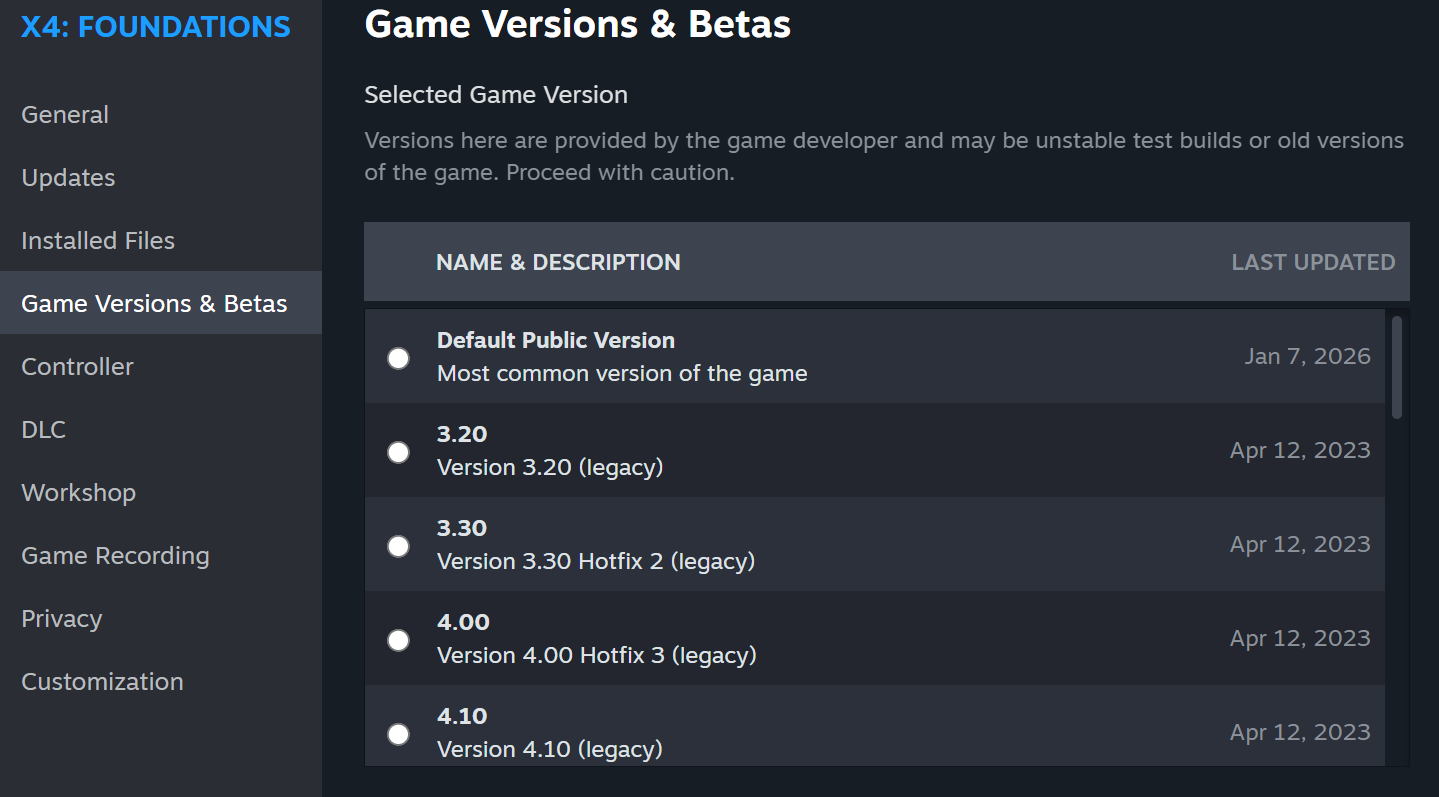
Tout d'abord, et c'est le point le plus important : si vous jouez actuellement sur du matériel ancien, vous ne perdrez pas l'accès au jeu. Nous savons que certains d'entre vous explorent l'univers X sur de vielles configurations, et nous voulons nous assurer que vous puissiez continuer à jouer. Nous continuerons de fournir l'accès aux versions héritées de X4 via le système de branches « Versions du jeu et bêtas » de Steam, comme nous le faisons déjà depuis un certain temps.
Comment accéder à une version antérieure :- Faites un clic droit sur X4: Foundations dans votre bibliothèque Steam.
- Sélectionnez Propriétés, puis accédez à l'onglet Versions du jeu et bêtas.
- Sélectionnez la version antérieure souhaitée dans le menu déroulant.
- Steam téléchargera la version sélectionnée, et vous pourrez jouer normalement.
Une fois l'opération terminée, Steam affichera la version du jeu actuellement sélectionnée à côté du bouton "Jouer", ainsi qu'à côté du titre X4: Foundations dans votre liste de jeux sur le côté gauche du client Steam.
Nous espérons que cette annonce anticipée vous laissera suffisamment de temps pour vous préparer. Nous vous sommes incroyablement reconnaissants pour votre soutien continu à X4: Foundations au fil des années, et nous avons hâte de vous montrer ce que cette nouvelle base technique nous permettra de réaliser à l'avenir. |
|
|
|
|
|
|
| 10.Jun.26 |
X4: Foundations 9.00 Mise à jour : Impériale est disponible aujourd'hui ! |
|
|
|
|
Nous avons le plaisir d'annoncer que la « Mise à jour : Impériale » (9.00) de X4: Foundations est officiellement disponible ! Cette mise à jour majeure et gratuite apporte de nouvelles fonctionnalités ainsi que des refontes globales qui améliorent la gestion de votre empire, que ce soit sur les plans militaire, stratégique ou économique.
Nous souhaitons sincèrement remercier la communauté pour ses retours inestimables, lors de la bêta publique 9.00, qui nous ont aidés à réaliser davantage d'améliorations ces dernières semaines. Votre contribution a été particulièrement utile pour ajuster avec précision les mises à jour de l'IA.
Voici un aperçu des fonctionnalités de la « Mise à jour : Impériale ». Pour approfondir ce qui vous attend, assurez-vous de consulter l' annonce de la bêta publique 9.00.
Pour un aperçu rapide des changements les plus importants, regardez notre vidéo d'annonce de la bêta publique 9.00 datant de mars 2026.
Les nouveautés de la mise à jour 9.00
Améliorations du combat
Nous avons apporté des changements radicaux à chaque aspect du combat dans X4: Foundations. Il s'agit de la mise à jour d'équilibrage du combat la plus importante de l'histoire de X4. Cela inclut un rééquilibrage complet de centaines d'armes, de tourelles, de boucliers et de vaisseaux afin de renforcer la profondeur tactique, de rendre viables davantage d'options et de corriger des incohérences. De plus, les tourelles sont plus précises, les pilotes IA se comportent de façon plus naturelle, les déplacements des grands vaisseaux ont été retravaillés, et bien plus encore.
Pour plus d'informations sur les changements importants concernant l'équilibrage des armes et des vaisseaux, vous pouvez consulter le sujet sur notre forum Public Beta Feedback (en anglais).
Recyclage des épaves kha'aks
Les épaves de vaisseaux kha'aks de tailles S et M peuvent désormais être recyclées, permettant la production d'Allographine, une nouvelle marchandise polyvalente utilisable pour la fabrication de vaisseaux et d'équipements. L'Allographine se transmute pour remplacer n'importe quelle marchandise dans le processus de production, offrant ainsi un moyen alternatif de pallier les pénuries de ressources.
Puisque la production d'Allographine nécessite du Nividium, cela ouvre de nouvelles opportunités commerciales à travers le réseau de portails. Certaines factions PNJ construiront également des stations de recyclage spécialisées pour utiliser cette ressource.
Pour en savoir plus sur le recyclage Kha'ak et les autres changements apportés à l'économie, vous pouvez consulter le sujet sur notre forum Public Beta Feedback (en anglais).
Changements visuels et modularité des vaisseaux
Les moteurs et les boucliers sont désormais intégrés aux modèles de vaisseaux S et M. Ce changement améliore leur apparence et augmente considérablement la variété des modules qu'ils peuvent équiper. Cette modification permet d'obtenir des identités visuelles plus affirmées et cohérentes pour les vaisseaux à travers tout le réseau de portails.
De plus, les emplacements des points d'emport des vaisseaux S et M ont été retravaillés, permettant une plus grande variété d'options d'armement. Par exemple, les vaisseaux borons et ceux de la Communauté des planètes peuvent s'équiper mutuellement de leurs modules, et ils peuvent désormais installer des armes et des tourelles plus petites.
Ordres prioritaires
À la demande générale, cette mise à jour introduit les Ordres prioritaires. Cette nouvelle fonctionnalité de l'interface permet de donner les ordres à la façon « STR », remplaçant instantanément toutes les commandes précédentes. Cela optimise la gestion des situations stratégique évoluant rapidement en éliminant la nécessité de configurer des listes d'ordres pour faire agir les vaisseaux immédiatement.
Les ordres peuvent être ajoutés en file d'attente depuis la carte via [SHIFT] + [Clic Droit], tandis que les ordres prioritaires peuvent être ajoutés avec [CTRL] + [Clic Droit] et mis en file d'attente (des ordres prioritaires) avec [CTRL] + [SHIFT] + [Clic Droit].
Ces modificateurs peuvent être utilisés dans n'importe quelle combinaison pour mettre des ordres en file d'attente ou en priorité dans le menu des ordres. Vous avez besoin qu'un commerçant récupère un coffre verrouillé à proximité et que son escorte attaque une cible proche ? Les ordres prioritaires vous permettent d'émettre ces commandes rapidement et sans perturber vos files d'attente existantes.
Module d'exposition de vaisseaux
Nous avons ajouté un nouveau module avec la mise à jour 9.00 : le Hall d'exposition de vaisseaux. Ce module permet aux joueurs d'entreposer et d'exposer leurs vaisseaux S et M préférés sur d'élégantes plateformes d'atterrissage.
Un ou plusieurs halls d'exposition de vaisseaux peuvent être rattachés à des stations appartenant déjà au joueur, ou même combinés en un complexe d'exposition pour présenter une collection plus vaste. Arriverez-vous à obtenir un exemplaire de chaque vaisseau ?
Évolutions de l'interface utilisateur
Les ajustements du style visuel de l'interface utilisateur ont touché tous les domaines du jeu, et nous avons accordé une attention particulière à l'amélioration des menus de l'écran de la carte. Ces modifications de la mise en page et du style de l'écran de la carte visent à améliorer la lisibilité tout en préservant la structure globale des informations affichées.
Pour plus d'informations sur les modifications apportées à l'interface utilisateur, vous pouvez consulter le sujet sur notre forum Public Beta Feedback (en anglais).
Amélioration de l'architecture des stations PNJ
Lors des précédentes mises à jour, nous avons permis aux factions PNJ de construire des stations plus imposantes. Dans la continuité de ces changements, la mise à jour 9.00 offre aux factions PNJ la capacité d'utiliser et d'étendre des plans de construction prédéfinis. Les stations basées sur ces modèles seront visuellement plus cohérentes et élaborées, permettant ainsi à nos concepteurs de peupler le réseau de portails avec des stations reflétant plus fidèlement l'identité de chaque faction.
Refonte des régions minières
Nous avons entièrement revu la gestion des zones de ressources, afin de répondre à plusieurs objectifs : de meilleures performances et une optimisation de l'utilisation de la mémoire, un contrôle accru des développeurs sur la distribution des ressources, et proposer aux joueurs une expérience de jeu plus dynamique lors de l'exploitation des gisements. Les ressources sont désormais localisées plutôt qu'éparpillées dans toute une région. De plus, lorsqu'une zone de ressources est épuisée, de nouvelles ressources peuvent apparaître ailleurs dans la même région.
Cela crée une nouvelle dynamique autour des opérations minières, dans laquelle les zones de ressources doivent, au préalable, être découvertes avant de pouvoir être exploitées, entraînant une fluctuation de la disponibilité des ressources imposant aux mineurs de chercher par eux-mêmes les emplacements de minage les plus rentables.
Nous avons également supprimé l'influence des sondes de ressources sur l'efficacité du minage. Les sondes de ressources indiquent désormais aux mineurs où concentrer leurs efforts, ce qui permet aux joueurs d'optimiser leurs installations de raffinage et de défense sans la pression d'une micro-gestion constante des sondes de ressources.
Pour en savoir plus sur le nouveau système de ressources, visitez le sujet sur notre forum Public Beta Feedback (en anglais).
Merci de la part de toute l'équipe d'Egosoft de jouer à X4: Foundations. Nous espérons que vous apprécierez les nouveautés de cette mise à jour 9.00 !
La « Mise à jour : Impériale » a peut-être quitté sa phase bêta, mais comme vous le savez, nous continuons de perfectionner le jeu sans relâche - continuez donc à partager vos commentaires avec nous, nous restons à votre écoute.
>> X4 9.00 Changelog |
|
|
|
|
|
|
| 03.Jun.26 |
La Mise à jour : Impériale de X4 (9.00) sortira le 10 juin 2026 |
|
|
|
|
Nous sommes ravis d'annoncer que la « Mise à jour : Impériale » (9.00) de X4: Foundations est prévue pour le 10 juin 2026 !
La « Mise à jour : Impériale » impacte chaque facette de la gestion d'un empire au sein de X4 - de l'équilibrage des vaisseaux et de leurs équipements à la chaîne de commandement, en passant par la répartition des ressources dans les secteurs, l'efficacité des pilotes et les opportunités d'expansion industrielle et commerciale dans tout l'univers.
Cette mise à jour apporte le rééquilibrage le plus important de l'histoire de X4 : des centaines d'armes, de boucliers et de vaisseaux ont été retravaillés pour corriger les éléments peu performants et améliorer considérablement la diversité des configurations viables. Les modifications apportées aux points d'emport des vaisseaux ont renforcé cette diversité en permettant d'équiper une gamme de modules beaucoup plus large sur l'ensemble des vaisseaux. De nombreuses améliorations de l'IA permettent désormais aux pilotes de se comporter de manière plus intelligente et en adéquation avec leurs rôles au sein des flottes.
Le nouveau système d'ordres prioritaires vous offre un contrôle immédiat, de type STR, sur vos vaisseaux depuis la carte, permettant un commandement plus réactif de vos flottes au cours d'opérations de combats dynamiques et exigeants. Cette nouvelle fonctionnalité s'accompagne de nombreuses améliorations de l'interface utilisateur à tous les niveaux.
Dans le même temps, une refonte complète du système de ressources a permis de rationaliser et simplifier les opérations d'extraction, tout en rendant la géographie galactique plus dynamique, puisque les ressources au sein des secteurs se déplacent une fois épuisées.
Parallèlement, les vaisseaux Kha'aks peuvent désormais être recyclés pour obtenir une nouvelle ressource qui, combinée au Nividium, crée une marchandise polyvalente capable de remplacer n'importe quelle autre pour la production de vaisseaux. Cela ajoute une couche économique supplémentaire permettant de résorber les goulots d'étranglement de la production, tout en offrant de nouvelles opportunités pour les opérations de recyclage et les commerçants.
Un nouveau module de station fait également son apparition : le Hall d'exposition de vaisseaux. Les joueurs·ses peuvent exposer leurs vaisseaux favoris grâce à ces modules, et les collectionneurs·euses les plus prolifiques peuvent même construire un complexe d'exposition dédié pour admirer leurs splendides collections.
La « Mise à jour : Impériale » est une mise à jour exhaustive, et de nombreux autres changements vous attendent. Pour en savoir plus sur les améliorations et les ajouts, consultez notre annonce détaillée.
Nous tenons à remercier tout le monde d'avoir joué à X4: Foundations, et plus particulièrement ceux qui ont participé à la bêta et nous ont fait part de leurs commentaires. Nous espérons que vous apprécierez toutes les améliorations de la « Mise à jour : Impériale » (9.00), qui sortira la semaine prochaine.
|
|
|
|
|
|
|
| 22.May.26 |
Interview with Helge Kautz: Loremaster of the X Universe |
|
|
|
|
We’re very excited to share a new episode of the Inside Egosoft podcast. Join our new host, Joey, as he speaks with members of the Egosoft team about their work and ideas. In this episode, he sits down with Helge Kautz, our loremaster. Helge is responsible for much of the worldbuilding in the X universe, having written multiple tie-in novels and being our go-to source for anything involving lore.
If you’re interested in exploring the lore further, we encourage you to check out the X Encyclopedia on the Egosoft website, as well as the tie-in novels.
For those who prefer to read, below you’ll find a breakdown of Joey’s discussion with Helge.
Be sure to tune in next month for another episode!
Listen to the Inside Egosoft Podcast:Helge Kautz: Loremaster of the X Universe
Joey: For people who might only know your name from the game credits or the novels, how would you introduce yourself and describe your role at Egosoft today?
Helge: I’m Helge. I’ve been working with Egosoft for 25 years or more, most of that time as a freelancer. I’m the author of the tie-in novels. There are five novels set in the X Universe, and I originated a lot of the back lore from the games. Now that I’ve been working directly for Egosoft for about a year and a half, I’m the loremaster, as well as an author and narrative director. That’s my role.
A Typical Day Building the X Universe
Joey: You mentioned you’re working full-time for Egosoft now. What does a typical day look like for you, if such a thing is even possible?
Helge: I typically come in, grab something to eat, and read through my work email to see if there’s information I should be aware of. There’s lots of interesting stuff there. Then I check my Discord mentions to see if anyone has tagged me and whether I need to respond. After that, I’ll have tasks like writing dialogue for an upcoming DLC or similar narrative work. That’s what I spend most of my time doing. From time to time, someone has lore questions or wants me to name something, and I’ll do that instead. So the day is maybe 75% typical, and the rest isn’t.
Writer First, Game Developer Second
Joey: You’ve been writing for a long time. How do you look at yourself these days? Are you a writer who works in games, or a game developer who writes?
Helge: I’m a writer first. A novelist is probably the right word. That’s what I am, and I’m always thinking as a novelist. I happen to write in game development, which requires different rules, but first and foremost, I’m a novelist. That has always been my passion and still is.
Early Science Fiction Influences
Joey: Can you talk about some of your early influences — books, films, or games that shaped how you write?
Helge: When I was about eight or nine years old, there was a science fiction book series for children. My grandparents would give me one of those books for my birthday and Christmas, and I devoured them. That really kick-started my passion for science fiction. The series had something like 30 books. There were also science fiction audio dramas. One was Commander Perkins. I’m not sure if it exists in the English-speaking world, but it was an action-packed series about a transporter device that takes people into different worlds and times. I loved that one. Then there’s the long-running German science fiction series Perry Rhodan, which I also read. As I got older, I moved on to authors like Larry Niven, Robert Heinlein, Arthur C. Clarke, and Orson Scott Card. Those stayed with me.
The Influence of Larry Niven
Joey: Are there any in particular that had a lasting impact on how you write?
Helge: Definitely Larry Niven. You may know the Ringworld series. He also has the Known Space series, including Ringworld Engineers, as well as books like The Integral Trees and The Smoke Ring. I read everything Niven wrote through the ’70s, ’80s, and ’90s. He’s my biggest role model, and I try to emulate aspects of his writing.
Science Fiction Grounded in Reality
Joey: What does that mean to you — his way of writing?
Helge: Niven tries to be scientifically accurate as much as possible, then introduces one unproven element like faster-than-light travel. Apart from that, everything feels grounded. He has colorful worldbuilding and great characters. Sometimes the character writing is very emotional. I love that, and I try to do the same.
From X: Beyond the Frontier to Farnham’s Legend
Joey: How did you first start writing for the X Universe? What was your first interaction with Egosoft like?
Helge: I’d been writing since I was about 13. In the late ’90s, I was working for THQ, the German publisher for Egosoft at the time. The sequel to X: Beyond the Frontier was being planned, and since I was part of the marketing team, there was discussion about including a bonus item in the expansion package — what today would be DLC. I suggested writing a tie-in novel. Everyone laughed. They said, “You’re the webmaster. Why would you write a novel?” I said I was sure I could do it. They asked me to write a demo chapter. I spent about six weeks planning, wrote it, and they said, “That’s not so bad. Let’s try it.” THQ then asked me to write the full novel, which became Farnham’s Legend.
Writing Novels vs. Writing for Sandbox Games
Joey: The X games are very open-ended sandboxes. How does writing for that universe differ from writing a fixed narrative?
Helge: From day one with Farnham’s Legend, it was clear the book is not the game, and the game is not the book. There are game mechanics you can’t really write into a novel because they would feel silly. In the game, they feel normal, but it’s different in prose.
Building the Lore of the X Universe
Joey: How do you approach building a universe?
Helge: Many authors start with planets and species. I don’t. I start with story and characters, and how they interact. Questions come up naturally. If we’re 1,000 years in the future, how do genders interact? Is there still marriage? As I write, I fill in these details and keep separate notes. My worldbuilding happens during writing, not before.
Hidden Details Players Might Miss
Joey: Is there lore you’re especially proud of, even if players might not notice?
Helge: There’s a lot people don’t know. For example, the meaning behind Teladi three-word names and their numerical elements. I have detailed explanations for that. There’s the marriage system in the Argon Federation and how it evolved. Language shifts over centuries. Cultural changes. There’s also what I call the “Argon phenotype,” referring to how humans in the Argon Federation look slightly different due to separate development.
Factions, History, and Isolation
Joey: Do you have a favorite faction?
Helge: The connection between the Argon and the Terrans is especially interesting — Earth, the discovery of the jump gates, the Terraformer War, and 750 years of lost contact. Something similar happened to the Teladi, who were cut off from Ianamus Zura without knowing the Terraformer War was responsible. Aldrin was also isolated due to Argon political decisions. There are many intertwined stories like that.
Collaborating with the Development Team
Joey: What’s it like collaborating with designers and artists at Egosoft?
Helge: Anything lore-related comes to me. If something changes about a species — size, eyes, fingers — I’m consulted. For example, the Split should have six fingers. I check things like that for lore accuracy. I also name most things now. I don’t influence weapon types or ship mechanics. I focus on naming and lore consistency.
The Challenge of Player-Driven Storytelling
Joey: Do you ever have to cut ideas you love?
Helge: Yes. The game is meant for players to create their own stories. I’d love to tell very specific character stories, but that isn’t always possible. That hurts sometimes, but it’s part of the process.
Looking Beyond the Current Timeline
Joey: What keeps you motivated after all these years?
Helge: We’re going to pass the year 825 eventually, where X4 is currently set. I’m excited to go beyond that point and explore the future of the universe.
How Far Ahead the Lore Is Planned
Joey: How far ahead have you planned?
Helge: Very far. I wrote a pitch set about 2,000 years beyond the current timeline, around the Earth year 5600. I know where things are going, but we won’t see that in the games anytime soon.
Advice for Aspiring Writers
Joey: Any advice for aspiring writers or worldbuilders?
Helge: Consume the medium you love as much as possible. If you want to write science fiction, read it constantly. Watch it, absorb it. Then write. Don’t expect your first work to be AAA quality. If you’re passionate and keep creating, you’ll grow into it.
Where to Start Exploring the Lore
Joey: If players want to dive deeper into X lore, where should they start?
Helge: The Encyclopedia of the X Universe on the Egosoft website is the best starting point. It’s a bit hidden right now, but we want to bring it forward more. It’s about 15 years old, but the core is still accurate, and I’m working on updates. Then, of course, the novels. They’re the best entry point into the lore.
Final Words to the Community
Joey: Any final remarks?
Helge: Thank you very much for the opportunity to talk about the X Universe. If players have questions about the lore, they can post on the forum or message me there. I’m happy to answer what I can. |
|
|
|
|
|
|
| 11.Mar.26 |
La bêta publique de X4 9.00 Mise à jour : Impériale est désormais disponible ! |
|
|
|
|
Nous sommes ravis de lancer la bêta publique de la "Mise à jour : Impériale" (9.00) de X4: Foundations ! Cette mise à jour majeure et gratuite comprend de nombreuses fonctionnalités et modifications qui transformeront votre approche du combat, de la stratégie et de l'économie.
La Mise à jour : Impériale comprend un rééquilibrage de centaines d'armes, vaisseaux et boucliers, ainsi que des améliorations majeures du combat qui mettront vos talents de pilote à l'épreuve. Associés à d'autres améliorations de l'IA, les combats seront plus dynamiques, plus exigeants et plus gratifiants.
En plus des améliorations de fond apportées aux combats, nous avons implémenté la fonctionnalité très attendue de Priorisation des ordres pour donner efficacement vos ordres - un atout indispensable pour gérer sereinement votre flotte au cœur des affrontements plus exigeants de la Mise à jour : Impériale ! De plus, notre nouvelle façon de gérer la création des éléments et objets du jeu nous a permis d'améliorer l'aspect visuel des vaisseaux et d'augmenter la variété des équipements dans la mise à jour 9.00.
Plusieurs fonctionnalités majeurs non liées au combat font leur apparition avec cette mise à jour : les vaisseaux Kha'aks peuvent désormais être recyclés en une nouvelle marchandise inédite et versatile ce qui ajoute une nouvelle dimension à l'économie, tandis qu'une refonte importante du système de zones de ressources modifie la façon dont de nouvelles ressources apparaissent après l'épuisement d'un gisement.
Cette mise à jour comprend également le nouveau module de station "Hall d'exposition" destinés aux collectionneurs de vaisseaux, des améliorations de l'interface utilisateur et de la carte, ainsi que des stations PNJ au caractère mieux élaboré, affirmant visuellement l'identité des différentes factions.
Pour plus d'informations et pour consulter l'intégralité des notes de mise à jour, nous vous invitons à lire cet article, et à rejoindre notre bêta publique pour les découvrir par vous-même.
>> Liste des modifications de la bêta publique 1 de X4 9.00
Comment participer à la bêta publique ?
Chaque joueur possédant X4: Foundations a la possibilité de télécharger la nouvelle version 9.00 en bêta publique. Afin de s'assurer que les participants à la bêta sont conscients des risques et règles impliqués, nous demandons à tous les joueurs intéressés de visiter notre forum, où ils trouveront les règles et les clauses de non-responsabilité, ainsi que des instructions pratiques pour participer à la bêta. Suivez ce lien vers notre forum (aucune inscription requise) pour accéder aux informations nécessaires.
Mécaniques de combat
Les changements les plus importants apportés au système de combat se situent sous le capot. Nous avons minutieusement travaillé sur un certain nombre de problèmes mineurs liés à la visée des armes. Chaque amélioration est relativement modeste en soi, mais l'effet combiné de ces efforts devrait avoir un impact positif significatif sur le ressenti et l'issue du combat : - La précision des tourelles a été considérablement améliorée.
- Les destroyers utilisent davantage leurs batteries principales, tout en bénéficiant d'améliorations au niveau de leur maniabilité et des tourelles.
- Le comportement de ciblage de l'IA a été amélioré pour le rendre plus naturel. En fonction des compétences du pilote, les manœuvres d'évitement et d'esquive latérale (straff) sont plus efficaces pour perturber la précision de tir des assaillants.
La mise à jour 9.00 comprend également une multitude de fonctionnalités de combat plus visibles :
- Les châssis des vaisseaux peuvent désormais posséder un facteur général d'échauffement des armes ; les vaisseaux dotés de nombreux canons sont par exemple susceptibles de surchauffer plus rapidement.
- De même, les châssis peuvent désormais inclure des modificateurs de bouclier pour une capacité ou un taux de recharge plus élevé.
- Les statistiques principales des moteurs, boucliers et armes sont désormais affichées sur l'écran d'équipement du vaisseau.
- Les torpilles peuvent désormais être verrouillées comme cibles et l'interception des missiles a été globalement améliorée.
- Le rechargement des munitions est désormais affiché sur l'ATH.
Mouvements des vaisseaux capitaux
En complément des améliorations apportées à la visée des armes dans la version 9.00, nous avons investi un effort similaire dans la refonte des mouvements des vaisseaux capitaux. Ensemble, ces changements influencent considérablement leurs performances au combat. Rendez-vous sur le forum Egosoft pour nous aider à tester ce point précis.
Rééquilibrage des vaisseaux
Nous modifions à la fois la taille physique des armes sur les vaisseaux S et M et les règles régissant leur installation. Cela permettra non seulement d'améliorer leur aspect visuel, mais aussi d'ajuster la compatibilité des armes. Rendez-vous sur le forum Egosoft pour nous aider à tester ce point précis.
Cette mise à jour comprend un rééquilibrage complet de plus de 200 armes et tourelles, de plus de 90 boucliers et d'une grande partie de nos plus de 200 vaisseaux. Ici, l'objectif est de résoudre les disparités, d'enrichir les possibilités tactiques et de répartir leurs forces et faiblesses de manière plus intuitive : - Les prix refléteront désormais plus fidèlement le niveau de qualité des vaisseaux et des équipements
- La vulnérabilité des vaisseaux de grande taille face aux armes légères a été réduite.
- Les vaisseaux lourdement blindés et dotés d'un bouclier constituent désormais une option plus viable.
- Les tourelles sont plus variées d'une faction à l'autre.
Recyclage des Kha'aks
Avec la version 9.00, les épaves de vaisseaux Kha'aks de tailles S et M peuvent désormais être recyclées. Le nouveau cycle de recyclage conduit à la production d'Allographine, un matériau transmutable qui peut être utilisé dans la production de vaisseaux et d'équipements. Lorsqu'elle est disponible, l'Allographine se transmute pour remplacer n'importe quelle ressource manquante en stock, offrant ainsi une alternative stratégique pour gérer les pénuries.
La production d'Allographine nécessite du Nividium, ce qui crée une demande accrue de Nividium et ouvre de nouvelles opportunités commerciales, particulièrement pour les entrepreneurs miniers. Plusieurs factions PNJ à travers le réseau de portails construiront des stations de recyclage spécialisées pour exploiter cette nouvelle ressource. Rendez-vous sur le forum Egosoft pour nous aider à tester ce point précis.
Refonte visuelle et modulaire des vaisseaux
Les moteurs et les boucliers font désormais partie des châssis des vaisseaux S et M, ce qui améliore en général l'apparence individuelle des vaisseaux et augmente considérablement la variété des modules que ces vaisseaux peuvent équiper. Bien que ces équipements n'affectent plus l'apparence de ces vaisseaux, ce changement nous permet d'affiner l'identité visuelle de chaque châssis de manière plus cohérente et structurelle.
Tous les vaisseaux S et M (antérieurs à Kingdom End) ont bénéficié d'une refonte de l'emplacement des points d'ancrage. Cela permet désormais, par exemple, aux vaisseaux borons et ceux de la Communauté des planètes d'interchanger leurs modules et d'équiper des armes ou tourelles de plus petite taille. Dans cette optique, l'intégralité des tourelles de taille M a été intégralement redessinée.
Ordres prioritaires
Les Ordres Prioritaires sont une nouvelle fonctionnalité répondant aux demandes des joueurs pour des commandes plus immédiates, de style "RTS", pouvant être données rapidement lors de scénarios intenses. Les Ordres Prioritaires seront toujours exécutés avant les ordres standards : l'époque où vous deviez ajuster manuellement la liste des ordres chaque fois que vous vouliez qu'un vaisseau agisse immédiatement est enfin révolue !
Les joueurs peuvent donner et mettre en file d'attente des ordres depuis la carte en utilisant [CTRL] + [Clic droit], ou ils peuvent donner des ordres prioritaires en utilisant [MAJ] + [Clic droit], ou combinez-les avec [CTRL] + [MAJ] + [clic droit] pour mettre un ordre prioritaire en file d'attente. Ces raccourcis peuvent donc être utilisés indépendamment ou combinés entre eux.
Ces modificateurs peuvent être utilisés pour définir des points de passage sur la carte ou pour mettre en file d'attente ou en priorité tout type d'ordre dans le menu Ordre. Vous voulez réparer rapidement un vaisseau, récupérer un coffre ou attaquer une cible spécifique sans avoir à vous soucier de la file d'attente des ordres ? C'est désormais possible.
Cela s'accompagne d'une modification du comportement du menu d'ordres : les ordres dans la file d'attente seront désormais écrasés et supprimés si aucune touche de modification n'est utilisée. Les joueurs peuvent toutefois inverser ce comportement dans les options pour éviter d'écraser accidentellement leurs files d'attente s'ils préfèrent l'ancien système.
Module d'exposition des vaisseaux
La mise à jour 9.00 introduit un nouveau module de station : le Hall d'exposition. Ce module permet de stocker et d'exposer vos vaisseaux favoris avec élégance. Selon le module d'exposition que vous construisez, vous pourrez exposer uniquement des vaisseaux de classe S, ou une combinaison de classes S et M. Il vous suffit d'amarrer un vaisseau vous-même ou de demander à l'un de vos pilotes de le faire, et le vaisseau restera exposé sur la plate-forme indéfiniment.
Vous pouvez ajouter un ou plusieurs Halls d'exposition à une station existante, ou utiliser uniquement ce module seul pour créer une station dédiée exclusivement à votre prestige : les collectionneurs les plus prolifiques pourront même construire de vastes complexes d'exposition, regroupant de nombreux modules, afin d'admirer l'armada de leur plus précieux trophées et acquisitions.
Il est important de noter que si un module d'exposition est détruit ou déconstruit, tous les vaisseaux qui y sont amarrés seront définitivement perdus.
Évolutions de l'interface et des menus de la carte
En plus de modifications globales apportées au style visuel et ayant été étendues à l'ensemble du jeu, nous nous sommes concentrés à apporter des changements plus spécifiques aux menus de la carte. Ces ajustements de la mise en page et de la présentation de certaines informations visent à améliorer la lisibilité, tout en conservant un format globalement identique à celui que vous connaissez.
Nous tiendrons compte des commentaires que nous recevrons sur ces modifications afin d'alimenter les prochaines itérations, non seulement pour l'écran de la carte, mais également pour les autres menus lors de futures mises à jour. Rendez-vous sur le forum Egosoft pour nous aider à tester ce point précis.
Une identité visuelle renforcée pour les stations des factions
Dans les mises à jour précédentes, nous avons permis aux factions de PNJ de construire des stations de plus grande envergure. Avec cette version, nous étendons cette fonctionnalité en permettant à l'IA d'utiliser et de développer des plans de construction prédéfinis. Les stations basées sur ces plans seront plus élaborées et visuellement plus cohérentes que celles générées par la méthode standard ; cela permet à nos designers d'exprimer plus clairement le style architectural et l'identité singulière propre à chaque faction.
Refonte des zones minières
Nous avons entièrement revu la gestion des zones de ressources afin de les rendre plus performantes et moins gourmandes en mémoire. Cette refonte nous offre un meilleur contrôle sur la distribution des matériaux, tout en vous proposant une expérience de jeu plus captivante.
La répartition des ressources au sein d'une région est désormais gérée différemment : elles seront localisées plutôt qu'éparpillées sur l'ensemble de la zone. Lorsqu'un gisement est épuisé, de nouvelles ressources pourront apparaître ailleurs dans la même région. Cela crée une nouvelle dynamique pour les opérations de minage : les zones de récolte devront être localisées avant d'être exploitées, entraînant des fluctuations de ressources plus marquées tandis que vos flottes de minage traquent les emplacements les plus rentables.
Et ensuite ?
Comme pour les précédentes mises à jour majeures, le développement ne s'arrête pas avec le lancement de la bêta publique. Cette phase de retours est un élément essentiel du processus, et nous nous engageons à peaufiner davantage cette mise à jour, en nous appuyant à la fois sur nos propres idées mais aussi, et c'est tout aussi important, sur vos observations. Nous vous invitons à partager vos réflexions et vos expériences dans le [url=https://forum.egosoft.com/viewforum.php?f=192forum de feedback de la bêta publique[/url] (en anglais), et à nous aider ainsi à façonner ensemble la version finale de cette mise à jour.
Merci pour votre soutien ! |
|
|
|
|
|
|
| Trouver d'anciennes nouvelles dans notre archive ... |
|
|
|
|
|
|
|
|
|
Community
|
|
|
|
|
Dernière capture d'écran
|
|
|
|
|
X4: Foundations |
|
| |
|